
Vozo
We may earn a commission if you sign up through our link · Affiliate disclosure
Facts verified:
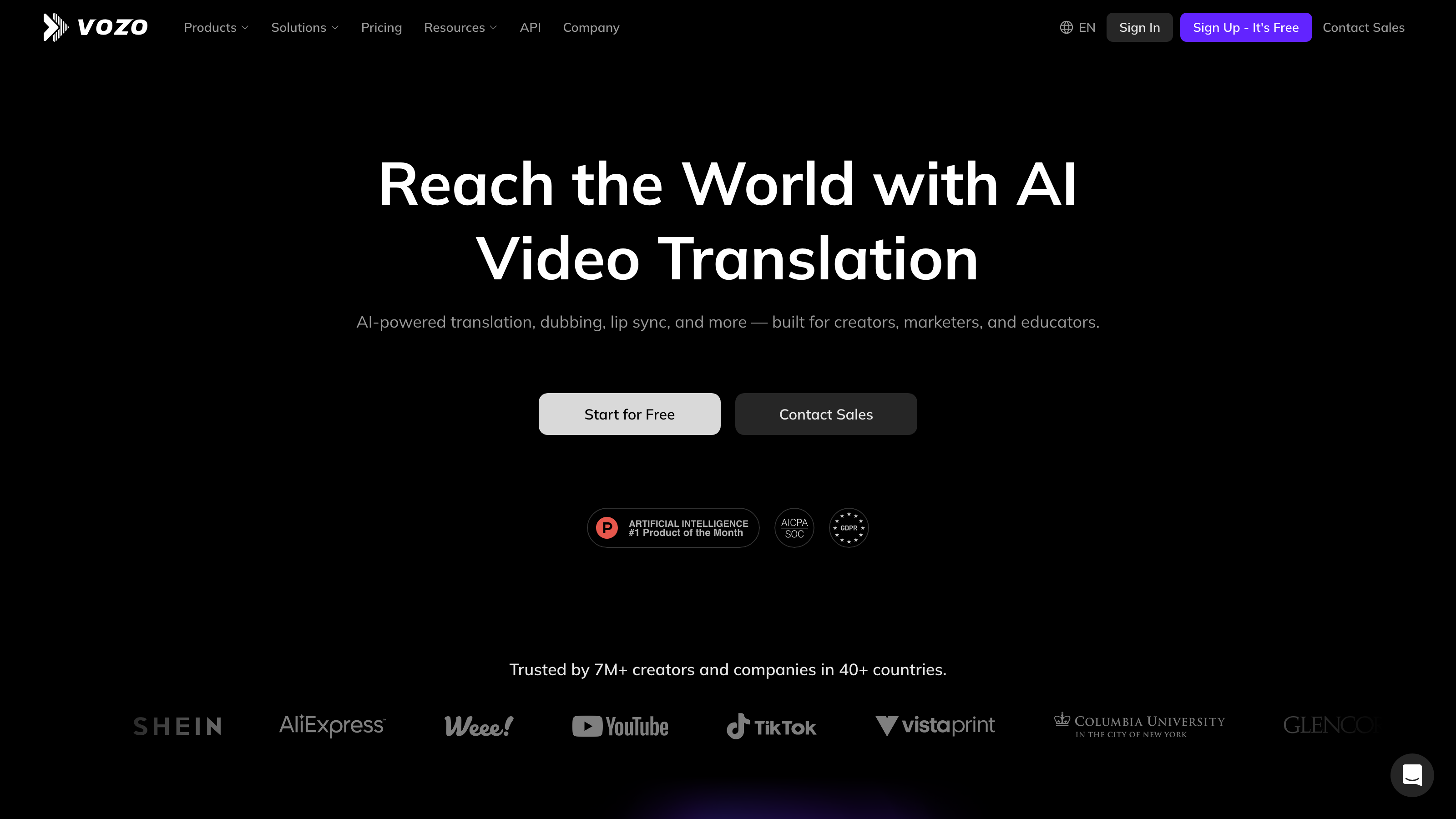
Vozo Review: AI Dubbing, Lip Sync, and Video Localization Tested
TL;DR
This Vozo review covers an AI-powered video localization platform that dubs, translates, and lip-syncs video content across 60+ languages. Vozo targets content creators, marketing teams, agencies, and educators who need to reach multilingual audiences without traditional production costs. Paid tiers run from $29/month to $649/month, with a free plan capped at 3 projects and roughly 6 dubbing minutes.
Overview
Vozo is a cloud-based AI video localization tool that handles dubbing, translation, lip-sync, subtitle generation, and voice cloning inside a single web platform. It addresses a real and growing problem: video content is expensive to produce, and re-producing it for each target language costs even more. Traditional localization requires translators, voice actors, recording studios, and video editors working together across time zones. Vozo compresses that workflow into an automated pipeline.
The platform is aimed at anyone publishing video at scale - YouTubers expanding into new markets, corporate communications teams localizing training content, and agencies managing multilingual social campaigns across Facebook, Instagram, TikTok, and YouTube. Rather than replacing a human production team for premium broadcast work, Vozo targets the large middle tier of creators and businesses that need professional-enough results at a fraction of traditional costs.
Vozo runs as a web app with an API available for developers who want to embed localization into their own Automation & Workflow systems. There is no desktop software to install. All processing happens in the cloud.
Pricing and feature details in this review were verified from the official site in July 2026.
Key Features
VoiceREAL and VoiceNATIVE Voice Cloning
Vozo offers two distinct voice cloning technologies. VoiceREAL and VoiceNATIVE Voice Cloning allow the platform to reproduce a speaker's vocal characteristics in a translated language. Instead of switching to a generic synthetic voice after translation, the dubbed output sounds closer to the original speaker. This is one of the more technically ambitious features in this category and directly addresses the "uncanny valley" problem common in cheaper AI dubbing tools.
LipREAL Lip Sync
LipREAL Lip Sync uses AI to match a speaker's visible mouth movements to the translated audio. When a video is dubbed into Spanish or Japanese, the mouth movements in the video are regenerated to match the new audio rather than leaving a visible mismatch between lips and sound. This feature matters most for talking-head videos, interviews, and spokesperson content where the face is prominently visible.
Visual Translation and Subtitle Translation
Vozo does not limit translation to spoken audio. Visual Translation handles on-screen text - titles, captions, lower-thirds, and graphics embedded in the video frame. Subtitle Translation generates synchronized subtitle tracks alongside the dubbed audio. Together, these two features make a localized video feel fully produced rather than partially adapted.
Proofreading and Editing Editor
AI translation is not perfect. Vozo includes a Proofreading & Editing Editor that lets users review and correct translated scripts before the final dubbed output is rendered. This is a practical acknowledgment that AI-generated translations sometimes miss nuance, terminology, or brand-specific language. The editing interface sits between translation and final export in the workflow, giving users a chance to catch errors before they are locked into the published video.
Glossary and Terminology Control plus Custom Translation Prompts
For businesses with specific product names, technical vocabulary, or brand guidelines, Vozo provides Glossary & Terminology Control. Users can define terms that must remain unchanged or be translated in a specific way. Custom Translation Prompts give further control over how the AI interprets and renders translations. These two features are particularly relevant for corporate communications, legal content, and technical training materials where a mistranslated term can cause real problems.
Multi-language Output from One Project and Bulk Upload
A single source video can produce dubbed outputs in multiple languages in one project, avoiding the need to run separate jobs for each target language. Bulk Upload extends this by letting users queue multiple source videos at once. For marketing teams or agencies managing content libraries, these two features are what separate Vozo from tools suited only for occasional one-off use.
Talking Photo and Long to Shorts Generator
Talking Photo animates a still portrait to speak with synchronized lip movement and voice - useful for ad creatives, explainer content, and social posts where sourcing video footage is impractical. The Long to Shorts Generator repurposes long-form video into shorter clips, directly relevant to publishing on TikTok, Instagram Reels, Facebook, and YouTube Shorts. These AI Apps for Videos features extend the platform beyond pure localization.
Team Workspaces, Admin Controls, and SRT/VTT Upload
For organizations, Vozo includes Team Workspaces & Admin Controls for managing multiple users and projects. SRT/VTT Upload & OCR Extraction lets users bring in existing subtitle files or extract text from video frames, saving time when subtitles already exist. Security, Compliance & Privacy features are noted specifically for enterprise use, including a confirmed commitment that enterprise customers' data is not used for model training.
Vozo: Pricing
Vozo uses a freemium subscription model with an AI points system that controls dubbing usage. Here is what each tier includes based on verified data.
Free - $0/month: Limited AI Translation covering 3 projects, 20 AI points for trial use, and approximately 6 AI dubbing minutes. This is a trial-level plan rather than a usable free tier for any ongoing work.
Creator - $29/month: Unlimited AI Translation, 150 AI points per month, and approximately 50 AI dubbing minutes. This is the entry point for regular individual use.
Studio - $99/month: Unlimited AI Translation, 600 AI points per month, and approximately 200 AI dubbing minutes. Suited to small teams or creators with consistent output volume.
Studio XL - $249/month: Unlimited AI Translation, 1,500 AI points per month, and approximately 500 AI dubbing minutes.
Studio XXL - $649/month: Unlimited AI Translation, 4,000 AI points per month, and approximately 1,330 AI dubbing minutes. This tier targets high-volume agencies or production houses.
Enterprise - Custom pricing: For organizations with custom high-volume or governance needs. Includes large volume discounts, security and compliance guarantees, and a confirmed no-training-on-your-data policy. Contact sales for details.
AI Point Packs: One-time add-on packs are available on any paid plan for users who exceed their monthly allotment without wanting to upgrade tiers permanently.
The points-per-minute conversion - roughly 3 AI points per dubbing minute at the Creator level - is worth checking carefully against your actual content volume before committing to a tier.
Who It's Best For
Content Creators and YouTubers: Creators publishing long-form or educational video content who want to reach audiences in multiple languages without re-recording. The Multi-language Output from One Project feature means a single upload can produce five dubbed versions in parallel. The Long to Shorts Generator also helps repurpose content for Instagram and TikTok.
Marketing Teams: Teams running multilingual campaigns across Facebook, Facebook Messenger, Instagram, Instagram Ads, and YouTube will find the combination of Visual Translation, Subtitle Translation, and Bulk Upload useful for scaling localized ad creative. Glossary & Terminology Control helps maintain consistent brand language across markets.
Agencies: Agencies handling video localization for multiple clients benefit from Team Workspaces & Admin Controls and Bulk Upload. The Studio or Studio XL tiers are the likely entry points at agency scale, depending on monthly volume.
Educators and Corporate Communications Teams: Organizations producing AI-Generated Training Materials, onboarding videos, or compliance content for global workforces can use Vozo to produce localized versions without re-shooting. The Proofreading & Editing Editor is important here, since accuracy in training content is non-negotiable and AI translation alone cannot be trusted for final output.
Startups and Small Business: Small businesses that publish product explainers, customer support videos, or social content and want to test multilingual markets without a large production budget can start at the Creator tier for $29/month.
Not the right fit - broadcast and premium production: If you are producing content where lip-sync artifacts or subtle voice cloning imperfections would be visible and damaging - such as broadcast television, premium brand films, or high-stakes executive communications - AI dubbing at any tier is not yet a reliable substitute for professional voice actors and manual post-production. For those use cases, a full-service localization agency remains the safer choice.
Alternatives
HeyGen: A well-known AI video generation and dubbing platform that also offers avatar creation and voice cloning. HeyGen has a larger public profile in the AI avatar space but serves similar use cases around localization and talking-head video. HeyGen leans more toward AI avatar generation, while Vozo emphasizes multilingual dubbing with lip-sync applied to existing footage.
Synthesia: Focused primarily on AI avatar-driven video generation for corporate training and communications. Synthesia is strong for creating fully synthetic presenter videos but is less focused on dubbing existing footage, which is Vozo's core use case.
Rask AI: A more direct competitor in the AI dubbing and localization category, with a similar points-and-minutes model and support for multiple languages. Worth comparing directly on output quality and per-tier pricing if Vozo's minute limits feel restrictive for your volume.
FAQ
How many languages does Vozo support? Vozo supports dubbing and translation across 60+ languages based on information available on the official site. The exact list of supported languages is worth confirming directly with the vendor, as coverage can vary by feature - some languages may have stronger voice cloning support than others.
Can I use Vozo output commercially? The verified product data does not specify commercial use rights by tier. Before publishing dubbed content in paid advertising - such as Instagram Ads or Facebook Ads - confirm commercial use terms in Vozo's current terms of service, particularly on the Free plan.
What is an AI point and how does it convert to dubbing time? An AI point is the internal usage currency Vozo uses to measure feature consumption. Based on the verified tier data, the Creator plan's 150 points equate to approximately 50 dubbing minutes, giving a rough conversion of 3 points per minute. Heavier features may consume points at a different rate.
Is there an API available? Yes. Vozo offers API access, which allows developers to integrate Vozo's dubbing and translation capabilities into their own applications or Automation & Workflow pipelines. API access details and rate limits are not publicly itemized in the verified tier data, so contact the vendor for specifics.
Does Vozo work with Microsoft Teams or other business platforms? The verified publisher data lists Microsoft Teams as a relevant platform context. However, the nature of that integration - whether it is a native connector, an API-based workflow, or simply a use-case reference - is not detailed in the verified product data. Organizations evaluating Vozo for Microsoft Teams-based corporate communications should confirm integration specifics directly.
Vozo: Final Verdict
This Vozo review finds the platform to be a credible, feature-rich option for teams and creators who need to localize video content at scale without rebuilding a production pipeline from scratch. The combination of VoiceREAL and VoiceNATIVE Voice Cloning, LipREAL Lip Sync, Visual Translation, and Glossary & Terminology Control puts it ahead of more basic AI dubbing tools on technical depth.
The ideal buyer is a marketing team, agency, or prolific content creator publishing regularly to multilingual audiences on YouTube, Facebook, Instagram, or TikTok. The Studio tier at $99/month is the realistic entry point for small teams; the Creator plan at $29/month suits individual creators with moderate output volume, specifically those needing fewer than 50 dubbing minutes per month.
The main caveat is the AI points model. Before subscribing, calculate your monthly dubbing minute needs carefully and compare them against the tier limits. Creators who regularly exceed 50 minutes per month at the Creator level will face escalating costs through AI Point Packs or a forced upgrade to the Studio tier at $99/month. The free plan is not a sustainable working option beyond initial evaluation. For premium or broadcast-grade content, human localization professionals remain the better choice.
The facts.
Pulled from Vozo’s own pages and dated so you can see how current each one is. Anything we could not confirm is left out rather than guessed.
- Free tier
- Yes checked Oct 2026
- Starting price / month
- $29/mo checked Oct 2026
- Cheapest paid tier
- $29/mo checked Oct 2026
- Pricing model
- Flat checked Oct 2026
- API access
- Yes checked Oct 2026
- Platforms
- web, api checked Oct 2026
- Enterprise plan
- Yes checked Oct 2026
Vozo pricing.
Pricing extracted from Vozo's site. Confirm before buying.
Pros & cons.
We don’t publish star ratings we can’t defend. These come from running Vozo on live briefs.