
Puppetry
We may earn a commission if you sign up through our link · Affiliate disclosure
Facts verified:
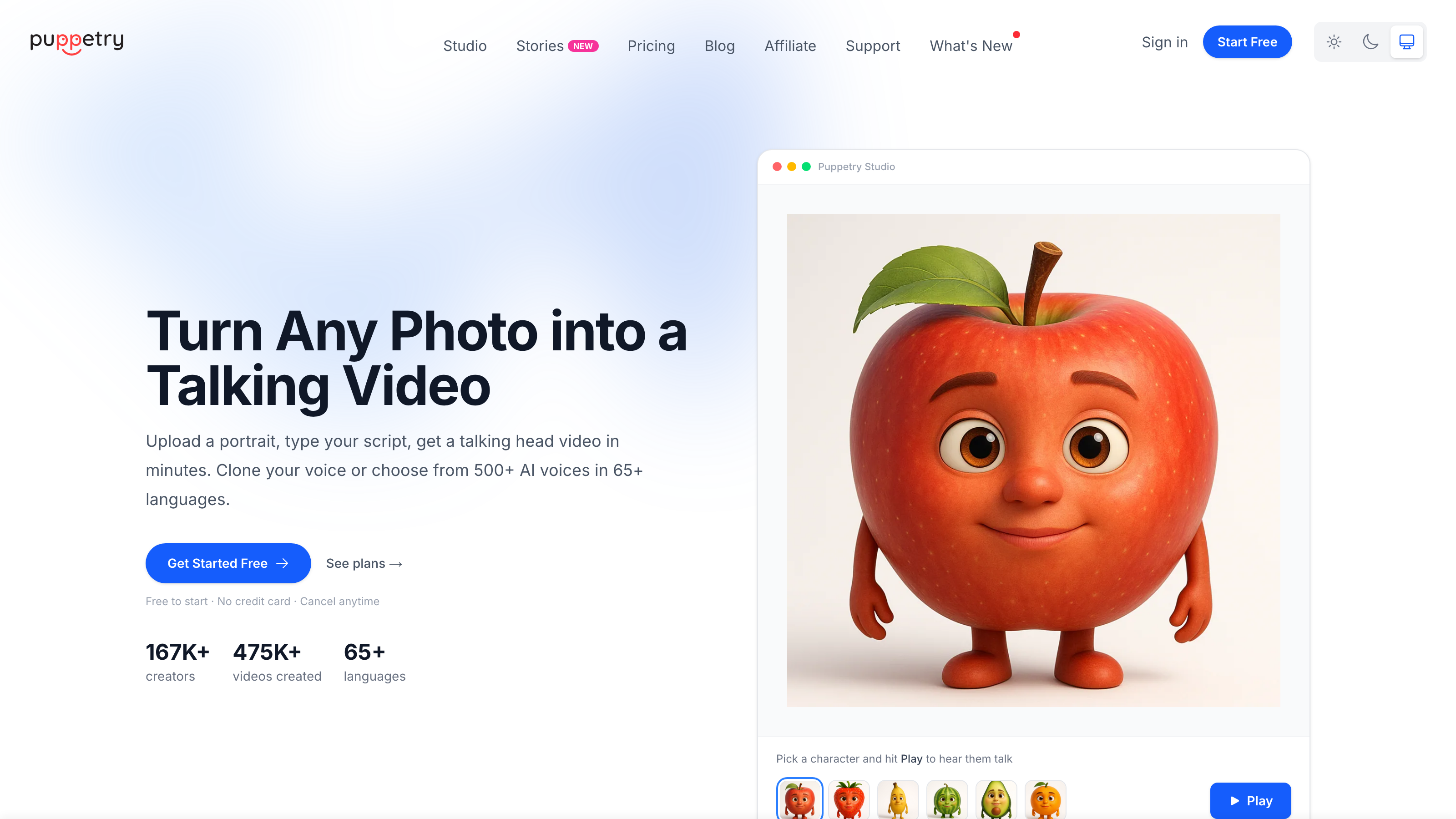
Puppetry Review: AI Talking Head Videos Without a Camera or Studio
TL;DR
Puppetry is an AI-powered platform that animates still photos into talking head videos using text or audio input, with 500+ voices across 65+ languages. It offers a free tier at $0/month (watermarked, 3 creations/month) and paid plans starting at $15/month for commercial use. This Puppetry review concludes the platform is a strong fit for content creators, marketing teams, and educators who need scalable, camera-free video output - but teams requiring a stable API or clearly documented editing features should test those capabilities on the free tier before committing.
Overview
Puppetry sits in the growing category of AI Apps for Videos - specifically tools that generate spokesperson-style content from static images. The core problem it solves is straightforward: producing talking head videos is expensive, time-consuming, and camera-dependent. Hiring an actor, booking a studio, and editing footage takes hours and budget that smaller teams rarely have.
Puppetry removes most of those barriers. You upload a photo, type a script or provide audio, and the platform generates a video of that face speaking your content - synced lips, facial expressions, and all. The output is suited to social media clips, explainer videos, training materials, and video ads.
The platform runs entirely on the web, with a Developer API (Beta) available for teams that want to build Puppetry's capabilities into their own products or workflows. Integrations with AI voice providers including OpenAI and ElevenLabs power the voice layer, giving the platform a wide selection of realistic synthetic voices.
This Puppetry review is grounded in verified pricing and feature data from the product's official site. Pricing and feature details in this review were verified from the official site in July 2026.
Key Features
Puppetry's feature set is focused tightly on video generation and voice. Below is a breakdown of what the platform actually offers, based on verified product data.
AI Talking Head Video Generation
This is the platform's headline capability. Puppetry animates any uploaded photo - turning a still image into a speaking character with synced lip movements and natural facial expressions. The output mimics realistic micro-expressions, which the vendor states helps results feel less robotic than older avatar tools. Marketers and educators can produce spokesperson content without sourcing human talent.
500+ AI Voices in 65+ Languages
Puppetry includes a large voice library covering more than 65 languages. This Multilingual Support is a practical advantage for teams producing content for international audiences or non-English markets. The breadth of the AI Voice Generation library also means users can match voice tone and style to the content type - formal for corporate communications, warmer for educational videos.
Magic Edit
Magic Edit is listed as a distinct feature, though the verified product data does not describe its exact mechanism in granular detail. Based on its placement within the platform's feature list, it appears to offer post-generation editing of video output. Buyers should test this feature directly on the free tier before upgrading, since the specifics of what "magic" editing covers are not fully documented in publicly available feature lists.
Story Maker
Story Maker allows users to build multi-scene video sequences rather than single talking head clips. This makes it more useful for structured content like explainer videos, educational modules, or narrative-driven ads - rather than one-off spokesperson shots. It adds a layer of storytelling structure to what is otherwise a clip-by-clip generation tool.
Audio to Video
Beyond text-to-speech, Puppetry supports Audio to Video generation - meaning users can supply their own recorded or pre-existing audio and have the AI animate a face to match it. This is useful for podcasters, voiceover artists, or anyone with existing audio who wants a visual presenter layer without re-recording.
Developer API (Beta)
The Developer API is in beta, meaning it is functional but may not be production-stable. Teams building custom workflows or embedding Puppetry's generation capabilities into their own tools can use this endpoint. The beta status is worth noting - API behavior and rate limits may change before a stable release.
Priority Rendering
Higher-tier plans include Priority Rendering, which shortens the wait time between submitting a generation request and receiving the finished video. On free or lower-volume plans, rendering queues may be longer. For teams with deadlines or high-volume needs, this is a practical differentiator.
Commercial License
Free tier exports carry a watermark and do not include a commercial license. Paid Creator and Studio tiers include a Commercial License, which is necessary for any content used in paid advertising, client deliverables, or monetized channels. This is a firm limitation on the free tier that buyers should account for when evaluating the platform.
Puppetry: Pricing
Puppetry uses a freemium model with four tiers.
Free - $0/month Includes 3 creations per month. Users can try every feature on the platform, but all exports are watermarked. There is no commercial license on this tier.
Creator - $15/month Includes 100 creations per month, access to all features, no watermark on exports, and a commercial license. This is the entry point for anyone using Puppetry for client work or monetized content.
Studio - $30/month Includes 300 creations per month, all features, no watermark, and a commercial license. Designed for higher-volume teams or agencies producing content at scale.
Enterprise - Custom pricing Aimed at organizations that need custom creation volume, SSO (single sign-on, a way for companies to manage employee login across tools from one system), or dedicated support. Pricing is not listed publicly - interested buyers need to contact Puppetry directly.
The step from Free to Creator is meaningful: watermark removal and commercial rights kick in at $15/month. The jump from Creator to Studio doubles the monthly cost for three times the creation volume, which makes Studio more cost-efficient for teams generating content regularly. Specifically, Creator costs $0.15 per creation at 100/month, while Studio costs $0.10 per creation at 300/month - a one-third reduction in per-unit cost.
Who It's Best For
Content Creators and Influencers Creators who need a consistent visual presence but do not want to appear on camera themselves - or who want to produce content at a pace that filming does not support - will find Puppetry directly useful. The 100-creation Creator tier at $15/month works out to $0.15 per video, which is a low cost for a regular publishing schedule.
Marketing Teams and Agencies Teams producing video ads, product demos, or social content for multiple clients benefit from the Studio tier's 300-creation volume and the included commercial license. The Audio to Video feature also supports repurposing existing recorded material into video format without re-recording.
Educators and Corporate Training Developers Puppetry's Multilingual Support and Story Maker make it practical for building educational or AI-Generated Training Materials in multiple languages. Educators producing course content or corporate teams building onboarding modules can generate presenter-led video without scheduling filming sessions.
Startups and Small Businesses Small teams that cannot afford video production budgets can use Puppetry to create spokesperson videos for landing pages, social ads, or sales outreach. The $15/month Creator tier is accessible for most small business budgets.
Developers Building Video Products The Developer API (Beta) opens Puppetry to teams that want to embed AI video generation into their own apps, platforms, or automated workflows. The beta status introduces some risk, but for developers testing feasibility, the API provides direct access to the generation engine.
Not the Right Fit: High-Fidelity Cinematic Production Teams Puppetry generates AI-animated talking head videos from static photos. It does not produce cinematic-quality footage, complex multi-character scenes, or live-action style video. A broadcast production team editing a national TV commercial, for example, will find the output quality and creative control far too limited. Tools like runway-style video generation platforms or traditional video production workflows are better suited to that need.
Alternatives
HeyGen HeyGen is a direct competitor in AI Talking Head Video Generation. It offers avatar-based video creation with a similar text-to-video approach, multilingual voice options, and a tiered pricing model. HeyGen's free tier is similarly limited, but it has a more established track record in enterprise deployment compared to Puppetry's current beta API stage.
Synthesia Synthesia focuses on AI Avatar Generation for business and training content, with a library of pre-built avatars and strong corporate use case positioning. It tends to be priced higher than Puppetry's Creator and Studio tiers but offers more polished templates suited to Corporate Communications and AI-Generated Training Materials.
D-ID D-ID provides a similar photo-to-video animation service with an API-first approach. It is a reasonable alternative for developers specifically, given its more mature API offering compared to Puppetry's current beta status.
FAQ
Is Puppetry free to use? Yes, Puppetry has a free tier at $0/month. It includes 3 creations per month and access to all features. The limitation is that all exports on the free tier carry a watermark and do not include a commercial license. To remove the watermark and use videos commercially, you need the Creator plan at $15/month or higher.
What file type do I need to get started? Puppetry is built around photo-to-video generation, so you start with an image of a face. You then provide either a text script (which the platform converts to speech using AI Voice Generation) or an existing audio file using the Audio to Video feature. No video footage is required to begin.
Can I use Puppetry videos in paid advertising? Not on the free tier. Paid advertising and client deliverables require a commercial license, which is included from the Creator plan ($15/month) upward. Free tier exports are watermarked and not licensed for commercial use.
Is the Developer API production-ready? The Developer API is listed as Beta, which means it is functional but not yet at a stable production release. Teams building on top of it should expect the possibility of changes to endpoints, rate limits, or behavior before a stable version ships. It is suitable for testing and development, but that risk should factor into any production deployment decision.
Does Puppetry support languages other than English? Yes. Puppetry includes 500+ AI voices across 65+ languages. This Multilingual Support covers a wide range of markets and makes it practical for producing localized or international content without sourcing separate voice talent for each language.
Puppetry: Final Verdict
Puppetry delivers a focused, functional set of tools for generating AI talking head videos from photos. The core workflow - upload a face, supply text or audio, receive a talking video - is well-supported by verified product data, and the platform's range of 500+ voices across 65+ languages adds real utility for teams serving diverse or international audiences.
The freemium entry point is useful for initial exploration, but the watermark and commercial license restriction on the free tier means teams need to move to the Creator plan ($15/month) before generating anything usable in a professional context. That is a reasonable price for what is offered. However, only 3 watermarked creations per month means buyers cannot fully evaluate output quality before paying.
This Puppetry review recommends the platform most confidently to content creators, marketing teams, and educators who need volume video output without filming. The Creator and Studio tiers represent fair value for those use cases.
The main caveat: the Developer API is still in beta, and Magic Edit's documented capabilities are thin. Teams whose buying decision depends on either feature should test both on the free tier before committing to a paid plan.
The facts.
Pulled from Puppetry’s own pages and dated so you can see how current each one is. Anything we could not confirm is left out rather than guessed.
- Free tier
- Yes checked Oct 2026
- Starting price / month
- $15/mo checked Oct 2026
- Cheapest paid tier
- $15/mo checked Oct 2026
- Pricing model
- Flat checked Oct 2026
- API access
- Yes checked Oct 2026
- Platforms
- web, api checked Oct 2026
- Enterprise plan
- Yes checked Oct 2026
Puppetry pricing.
Pricing extracted from Puppetry's site. Confirm before buying.
Pros & cons.
We don’t publish star ratings we can’t defend. These come from running Puppetry on live briefs.
AI-generated analysis; edited and accountable: Tom Young. Data is verified from vendor sites on a dated schedule, not hands-on trials.
- Verified
- July 2026
- Pipeline
- 2026.07.04-1
- Checks run (2)
- author, quality_review
- SEO score
- 68
- Evidence sources (1)
- puppetry.com